How film works
Negative, development, print: the photochemical chain in plain language, and what each step does to a picture.
The negative
Colour negative film has three layers of light-sensitive silver crystals, stacked on top of each other: blue-sensitive on top, green in the middle, red at the bottom. Each layer holds fast, large crystals and slow, small ones. When light hits a crystal, it becomes developable.
A negative is made to record a lot: over 14 stops of scene light, at low contrast. It's not meant to be looked at. It's an intermediate, like a raw file.
Grain
In development, each exposed crystal becomes a cloud of dye. Those clouds are the grain. Where only a little light fell, only the big, fast crystals responded, so shadows are coarse. With more light, the small ones join in and the grain gets finer. That's why overexposed film looks cleaner.
Halation
Bright light goes all the way through the emulsion, reflects off the back of the film base and comes back. On the way back it hits the red layer first, so bright lights get a red-orange halo. Modern stocks have a dark backing that absorbs most of it.
Development
As crystals develop, they release by-products that slow development next to them. Edges between light and dark get crisper, and colours separate. At the same time, light scattered inside the emulsion softens the finest detail. Film is softer than a sensor and crisper at edges at once.
The lab and the print
The negative is printed onto print film. The lab sets the printer's red, green and blue light in points, about six to a stop, to balance each shot. The print stock then turns the low-contrast negative into a picture with deep blacks, a soft shoulder and its own colour.
That's why the same scene looks different on film: every step changes what the next step sees. onelight runs the same steps in the same order.
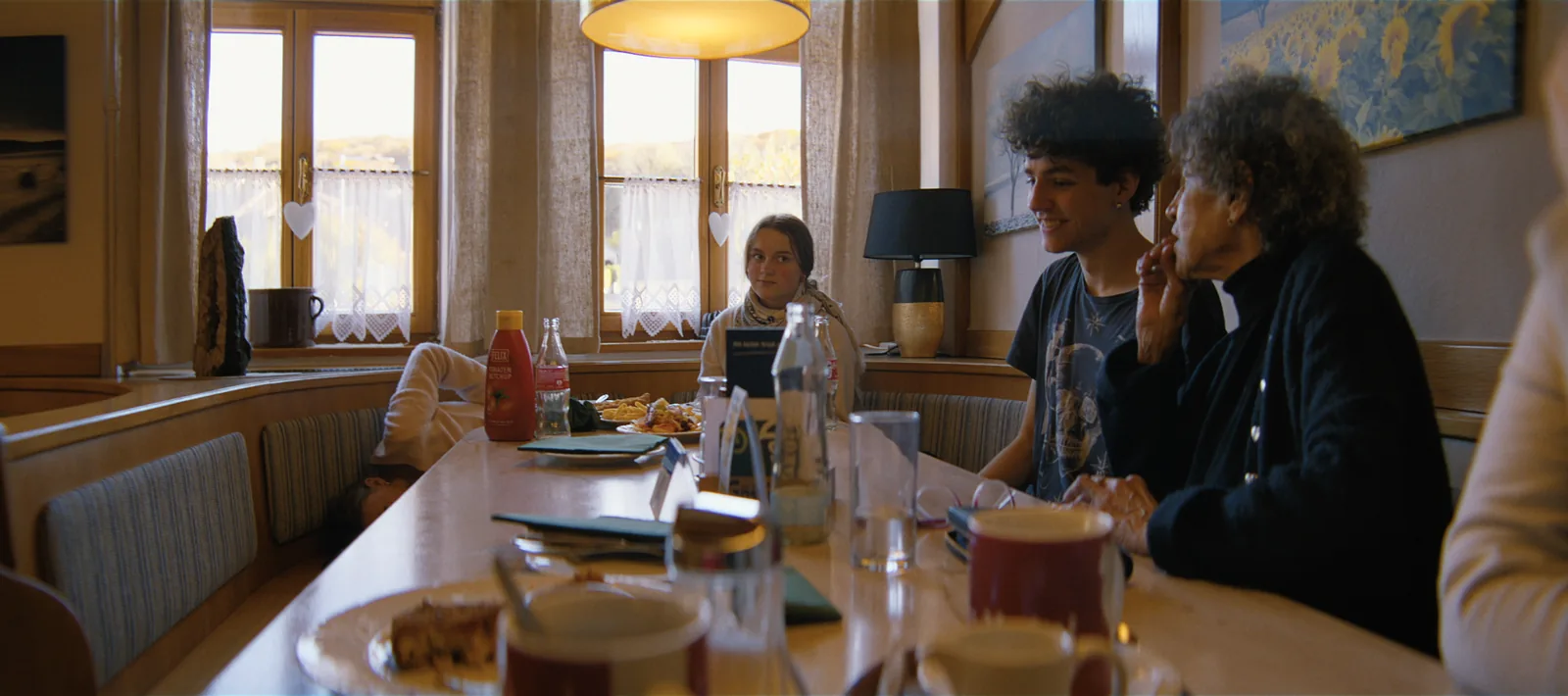
Shot digital. Printed on film.
Try every feature free for 14 days. No card needed.